
And they do require managing. Peas are probably the most labor intensive thing I grow, but the vegetable we look forward to the most. “Plant as many as you want, Mom,” they say. “We’ll help you pick them.” Of course, this is a bit of a joke because I don’t let the children pick peas without supervision. The plants are too finicky and it’s hard to tell when they are ready.
You have seen this photo before, of my over-achieving pea vines, over five feet high. If I had planted them 3 weeks earlier, I feel confident that the yield would have been better. Honestly… 6 quarts in the freezer and a few quarts eaten fresh is not a stellar outcome. Next year I will shoot for planting in mid-April instead of early May. They should not be this yellow while still bearing pods. My bad.

I did three different versions of plantings in my mulched section. Row 1: we raked the old hay aside and let the ground dry a bit before tilling up that strip and planting a double row. We did not re-mulch until the peas were up. Row 2: we raked the hay aside, but did not till the row. Instead we made a shallow row with a hoe and planted a double row. Row 3: we used a string stretched from one end to the other as a guide, and simply poked holes in the soft soil to drop the peas into, leaving the old hay/mulch just as it was. The last method seemed to work the best, maybe because we had an uncharacteristically dry spring. Those peas came up more quickly and climbed up the support fence we put in between the rows. The other two methods caught up, but obviously the tilling and hoeing were not necessary.
We had three double rows, 25 feet each, 150 feet of peas total. The reason for this is that the fencing we use for support comes in 25 or 50 foot lengths. Cutting them in half makes the rolls easier to manage and store. There is psychology involved as well. A 25 foot row is not nearly as daunting to pick as a 150 foot row.
Peas need support to grow, unless you want to bend over to pick until your back is screaming to buy Del Monte mushiness in a can rather than try to grow your own peas. It’s a valid option, but not one we choose.
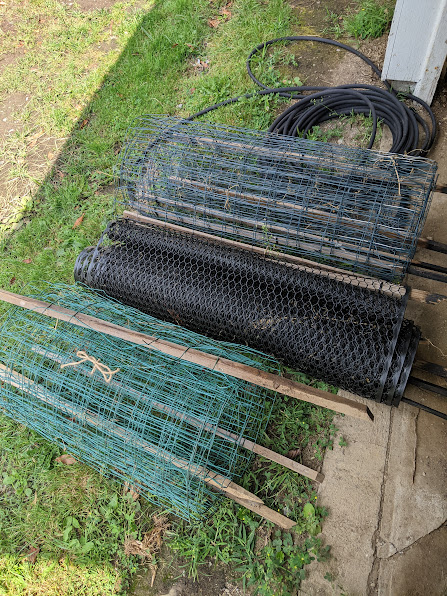
As you can see in the photo below, we have a variety of fencing materials. The bottom, PVC coated wire, was some we had on hand from our farm days, probably to keep ducks where they ought to be. It is sturdy and would be fine except it is only 2 feet high. The peas didn’t have enough support and doubled over the top. The black plastic chicken wire seemed like a good idea, but even with the fence zip-tied to holes drilled in the wooden posts, it sagged under the weight. We will still use it, but it will require twice the amount of posts. All the way at the top is the priciest option, 3 foot high, PVC coated wire mesh. We have had that fence for years. It was a good choice and I wish we hadn’t wavered when we saw the price difference this spring when we needed more.
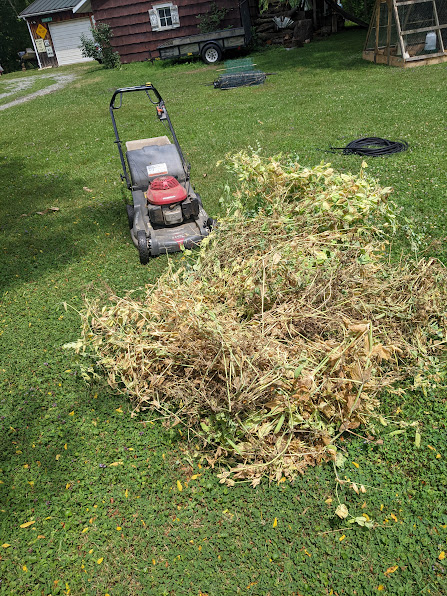
I pulled the vines yesterday and before I threw them onto the compost pile, I had a lightbulb moment. Aha! I can chop them up and let them compost right in the spot where they were growing. It worked too! The lawnmower coughed and choked a little, but in the end we prevailed. I had laid down a fresh layer of cardboard before I dumped the chopped peas back into the garden. That should smother any opportunistic weeds that were growing alongside the peas.

I want to plant some more fall broccoli/cabbages in that spot. The other pea row got replanted with more green beans and a hopeful seeding of sugar peas for fall consumption. I don’t know how well that will work, but I had old seeds that needed to be used, so I threw them in. I covered them with old hay, no bare spots. Low stakes, so we shall see.
Recently I read an article that stated this: “Whenever the soil is tilled, the subterranean community of lifeforms within it is hit with a hurricane. All the bacteria, protozoa, nematodes, and fungi that sustain and support plant growth are thrown into chaos, season after season. Weeds often help to bring them back to balance, like aid workers after a disaster. The way that creation keeps the soil healthy, building it generation after generation, is by always keeping it covered.”
That is why I am so fascinated with my no-till experiments. If you ever noticed how quickly nature covers up bare soil with plants, you will know what I mean. I do not like having an unsightly, weedy garden. With the traditional methods of tilling, it meant getting out the rototiller at regular intervals, and hoeing the rows as well. Keeping the soil covered with mulch or cover crops, while not truly “no-work”, is certainly less work. For me, the secret to enjoying gardening is to keep it to manageable proportions. I use anything that decomposes cleanly for layers of mulch: cardboard, newspaper, old pine straw, wood chips, chopped vegetable stalks, dead leaves, etc. Any slimy peelings or kitchen scraps get thrown onto a compost pile that I neglect shamelessly. I hope it eventually turns into useful compost, but until then I just keep adding to the top.
I get lots of good ideas from the experts, but I do whatever I jolly please in my own bit of earth.
That means planting flowers with the vegetables, filling in the cracks with last minute delights such as broom corn or black beans that bloom purple or spaghetti squash that may or may not take over the space entirely. I don’t play by the rules, and that is why I have so much fun. 🙂
I want to conclude with a funny story. Mennonites love iced mint tea. We call it meadow tea, garden tea, fuzzy mint, spearmint, etc. Awhile ago our elderly neighbor came over for a visit, I offered him a glass of chilled spearmint tea, explaining what it was as I handed it to him. He took a tentative sip and murmured, “Hmm, kind of piney.”
How about we raise a glass of iced mint tea to happy gardeners everywhere!

 wocket in my pocket